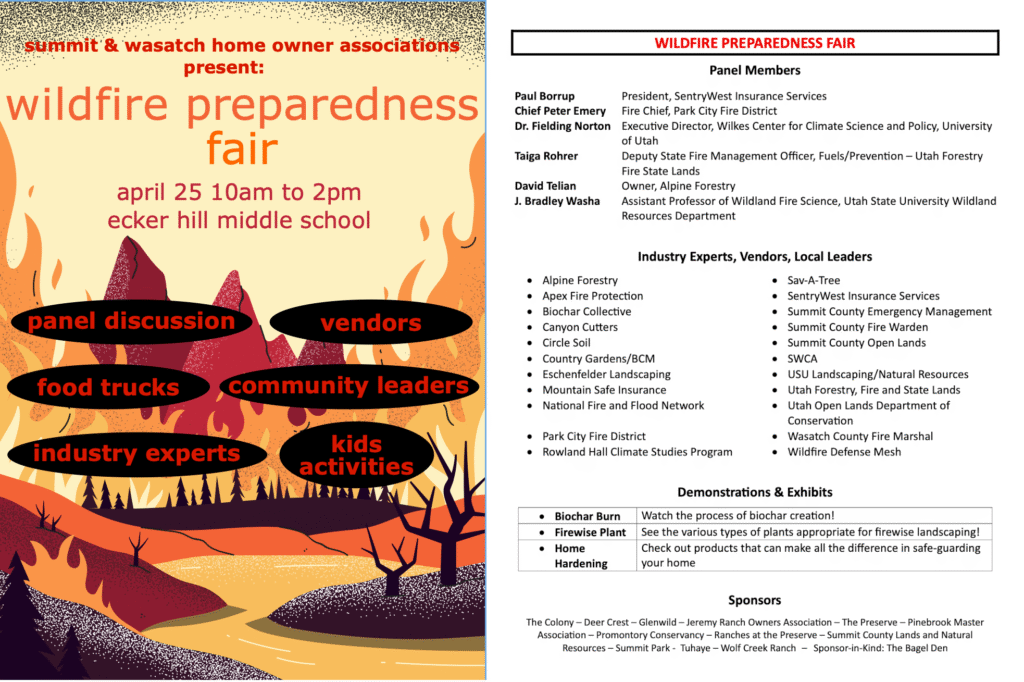
Wildfire Risk Discussion
Panelists’ Bios
Paul Borup, President, SentryWest Insurance Services
Paul’s insurance career spans more than two decades, including senior roles with multiple Fortune 100 insurance companies. His background includes experience as a claims representative, product manager, and financial officer, giving him a practical understanding of insurance from policy formation through claims resolution. His work at SentryWest, since 2019, is grounded in firsthand experience with how insurance decisions play out operationally and financially over time. Paul is a Chartered Property and Casualty Underwriter (CPCU). He holds an MBA from the University of South Carolina and a Bachelor of Science from Utah State University.
Chief Peter Emery, Fire Chief, Park City Fire District
Chief Emery leads the Park City Fire District (PCFD) with two decades of dedicated service to the community. Since joining the district in 2005, Chief Emery has risen through the ranks to now oversee the strategic direction of an organization serving a rapidly expanding residential base and millions of annual visitors. His vision for PCFD is centered on operational excellence, professionalism, and compassion, while focusing on specialized training to ensure the force is prepared for the unique geographical and technical challenges of the region. Chief Emery prioritizes mitigation strategies for the Wildland Urban Interface “W-U-I” and champions “Firewise” partnerships between first responders and stakeholders, with public safety as a shared responsibility.
Dr. Fielding Norton is the Managing Director of the Wilkes Center for Climate Science & Policy at the University of Utah
Fielding Norton is Managing Director of the Wilkes Center for Climate Science & Policy at the University of Utah, where he focuses on turning climate science into decisions communities can act on—especially for risks like wildfire here in the West. He trained as a climate scientist, earning his Ph.D. from Harvard, and then spent more than 25 years in the global insurance and reinsurance industry, using science and engineering models to understand, price, and manage risk from events like wildfires, floods, and hurricanes. More recently, he co-founded a climate-focused insurtech company using AI to better price risk and reward resilience. Today, his work includes helping communities like those here today stay not just safer—but insurable—in a world where wildfire risk is growing.
Taiga Rohrer is the Deputy State Fire Management Officer of Fuels & Prevention with Utah Forestry Fire State Lands
Taiga has a Master of Science degree in Forestry – Fire Ecology and Management from University of Montana and has worked in fire and fuels management for 38 years. He has held fire management positions with the Bureau of Land Management, US Forest Service, and the National Park Service in Idaho, Montana, and Colorado, and is currently with the State of Utah. He has attained numerous qualifications and has developed, planned, and led large, interagency prescribed burns and large Wildland Urban Interface fuel reduction projects. He has worked with various volunteer fire departments, and continues to participate in Incident Management Teams as an Incident Commander.
David Telian is the Co-Owner and Founder of Alpine Forestry
David has spent over 20 years working on the front lines of wildland fire, forestry, and fuels management. His career has encompassed both public and private sectors, serving for 15 years in federal agencies and local government. In 2020, he pivoted into business, and launched a company based in Park City, which seeks to bring an experienced and holistic approach to land management at any scale. He is passionate about utilizing his certifications, field knowledge, and collaborative leadership to help solve local environmental issues.
Brad Washa is an Assistant Professor of Wildland Fire Science in the Wildland Resources Department at the Quinney College of Natural Resources with Utah State University Extension
After more than 33 years in wildland fire management with over 400 wildland fires, Brad retired in 2021 as the State Fuels Specialist for the Bureau of Land Management in Utah. Brad’s experience with western wildfire includes the being on the Helitack Crew at Mesa Verde National Park, National Interagency Fire Center, the Department of Interior’s Office of Wildland Fire, Bureau of Land Management, U.S. Forest Service, The Nature Conservancy, U.S. Fish and Wildlife Service, and the Wisconsin Department of Natural Resources. Brad holds a MS in Wildland Fire Science from Colorado State University along with a BS in Natural Resource Management and Political Science from University of Wisconsin-Stevens Point.
Q & A
WILDFIRE-GENERAL INFO
Can you explain how a wildfire moves through an aspen grove? Do aspen trees typically burn if fuels are removed from around the aspen trees?
Pure aspen stands are considered to be shaded fuel breaks and wildland fire spread is limited. Following leaf fall, in the autumn, fire can spread within aspen stands, but with low intensity. If conifer encroachment occurs into aspen stands, fire can easily spread through the stand. Aspen is a thinly barked species and fire will typically kill aspen trees, but aspen place a lot of energy into their roots and able to aggressively resprout if the above ground part of the tree is killed. Thus removing fuels from around aspen will reduce fire behavior.
A theory that ski runs provide fire breaks above the communities, drought and fuel loading seem to drive bigger hotter fires. Is the “fire break” theory true?
Ski runs typically run lateral downslope and while cross-slope movement of fire spread can be limited, such runs will not stop upslope runs. Mid-slope runs also offer limited opportunities to hold a wildfire. Ridges, roads, and rivers are many times looked at for holding features when managing a wildfire. Thus ski runs on ridges can offer opportunities as fuel breaks, but will not stop the fires spread without suppression action. Gladed ski runs can help in reducing fire behavior and keep fire on the surface vs. moving into the crowns of trees along with providing greater resiliency for the trees if fire burns through an area.
What can we do to ensure our trees stay healthy or to keep disease/pests (balsam woolly adelgid and fir engraver were mentioned) out of our landscape?
Insects are many times drawn to a specific host tree species. A number of insects have been impacting the forest health of the native tree species within the greater Park City area. There is limited evidence on managing forested stands to reduce impacts on current insects that have been infecting our forests. Many of the forested stands are experiencing stress from overly dense stands of timber, in part from a lack of fire to thin out the forest, enhanced by drought and impacts from climate change (i.e. winters are not getting as cold and remaining cold to kill the insect populations over the winter months).
White fir – Has been impacted by the fir engraver beetle, but it appears this outbreak has stabilized since a peak around five years ago. There are no solid management recommendations. We do not have effective lures or repellents for this species, and literature examining thinning treatments is minimal. Silvicultural practices aimed at reducing white fir density within a stand offer the best chance for limiting fir engraver-caused mortality.
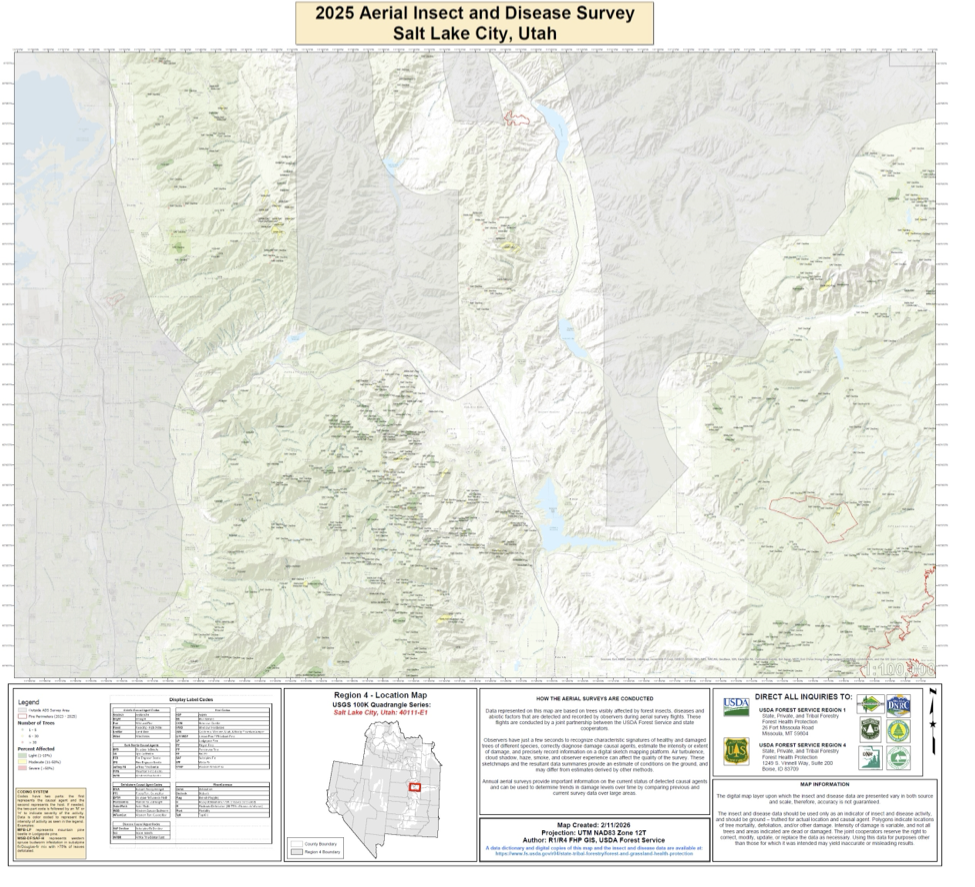
Subalpine Fir – Balsam woolly adelgid (Adelges piceae), a defoliator, is a tiny sucking insect identified as an invasive species introduced to North America from Europe. It is a damaging insect of true fir species. In Utah, subalpine fir (Abies lasiocarpa) is a highly susceptible host tree with white fir (Abies concolor) also a host, but identified as being more tolerant (Ragenovich & Mitchell, 2006). In September 2017 BWA was first confirmed in Utah including Summit County (Utah Forest Health Highlights 2019). The USDA Forest Service’s 2025 aerial insect and disease survey detected balsam woolly adelgid (BWA) and Subalpine fir decline within the greater Park City area. BWA is a nonnative tree-killing insect is invading northern Utah, attacking subalpine fir and potentially triggering yet another die-off of the region’s long-stressed conifer forests. Unlike beetles that gnaw and burrow through the phloem under the trees’ bark, the much smaller, flightless adelgid sucks out the needles fluids and leaves behind a toxic saliva.
Douglas fir – Douglas-fir beetle prefers larger diameter, older trees, especially if they become stressed by drought and warmer temperatures. On a positive note, there are options to manage the Douglas fir in this area includeing using MCH repellents along with thinning of larger trees to reduce overall stand density, average diameter, and stand age. MCH is a naturally occurring anti-aggregation pheromone. Pockets of Douglas-fir beetle were noted in 2025 within the Summit Park area.
Is there any research being done on the relationship between groundwater recharge as a defense/deterrent for ignition?
Based upon study from South America, groundwater recharge can indirectly influence wildfire risk by modulating vegetation health, soil moisture, and landscape flammability. While it is not a direct fire suppression mechanism, its role in maintaining ecosystem resilience can help reduce the likelihood and severity of fires.
While there is limited research occurring on wildland fire relationship with groundwater recharge, a number of studies have occurred looking at potential fire severity and impacts to watersheds within Utah. One study does show concern for potential of a severe wildfire in the Weber Basin and impact to Rockport Reservoir that provides culinary water to Park City. Research further shows that utilizing cost-effective treatments optimizes risk reduction within the watershed that feeds Rockport Reservoir.
HB48
How do I sign up for assessment of my property as required by HB 48 and when will lot assessments start?
On the FFSL website https://ffsl.utah.gov/wildland-fire/prevention-preparedness/community-preparedness/#resources there is a link to fill out a form “High Risk WUI Property Assessment Request” –https://docs.google.com/forms/d/e/1FAIpQLSfp68DdVrXWfFjtfBNFMTT-COGJLa0pI47H1Uc0VW9ZAHFpwQ/viewform
Who/what agency is responsible for enforcing wildfire mitigation for private homes?
This is a municipality and county enforcement issue, contact your city or county government to find out which department/role does this.
Can you discuss HB 48?
More information is available at https://ffsl.utah.gov/wildland-fire/prevention-preparedness/community-preparedness/
If one is in high risk but not very high risk, what is the probability of wildfire to my home? Not red, but orange?
Great question, this allows us to clear up a few things. First the High-Risk WUI Map is at https://wrap.wildfirerisk.utah.gov/Map/Public/#whats-your-risk and using the “Map Themes” button allows you to select the High Risk WUI Properties which solely identifies the areas which the HB-48 WUI Modifications is effective including the fee and lot assessment as well as where the insurance industry must only call high risk. This represents where structures are dense enough and have a Very High or higher Smoothed Structure Exposure Score which indicates the statistically significant 95th percentile of risk across the state. But that is a line required by the state legislature for calling an area High Risk, notably though that does not mean there is no risk on the other side of the line, it could be 94.9%… not very comforting. So this is an excellent observation, because it recognizes there is still risk outside of what is defined as High Risk. In fact all Wildland Urban Interface Areas are in some level of risk and everyone in the WUI should takes steps to minimize their individual risk and lower the probability of wildfire impacting their home. If you are in UWRAP and select the “Smoothed Structure Exposure Score” theme you will see rating colors across the state from 1 “Little to No Exposure” to 8 “Extreme Exposure” representing risks to structures if there are any in those areas. There is always risk from wildfires, but this should help with understanding your risk relative to others. Ideally if you have any risk you will apply the Firewise Defensible Space and Home Hardening Principles to your property to provide you the best probability of not damaging or losing your property in a wildfire. The “Burn Probability” theme in UWRAP can also give you a probability of a fire occuring in your area any particular year.
COAs differ from HOAs in ownership/responsibility of all land in development. What is being done to recognize this in risk level determination and assessments?
Wildfire risk is independent of ownership or organization, the question is who is responsible. Bottom line is you need to read the COA or HOA documents and determine ownership and responsibilites for your specific situation. Ultimately for the purposes of the High-Risk WUI, or any WUI for that matter, the property owner or owners are responsible. If the HOA or COA owns the land and is responsible for the exteriors of structure, they are responsible for home hardening or defensible space. Really what will matter how each organization is structured and what their responisbilites cover. Generally the entity the tax bill goes to is responsible. A condo owner would have difficulty doing anything substantive outside of what they specifically own by themselves, for that reason a COA who is typically responsible for the shared land and maintenance thereof as well as the outside of multi-dwelling structures and maintenance thereof, will be the entity that needs to address the wildfire risk and request the lot asssessment. The property owners, including the COA and condo owners will be paying the fee, making the incentive of getting an assessment and mitigating risks all that more attractive. The individual condo or home owner should be ensuring the COA or HOA is aware of this and addressing it. The legalities of a COA or HOA not addressing the risks of managed land/strucutres if individual condo or home owners want it addressed is a question better left to legal professionals. HOAs are set up in a variety of ways as far as what is covered by the HOA, so it will differ accordingly who is responsible for what.
COMMUNITY MITIGATION
We live at the top of Jeremy Ranch up against the greenspace. How can we protect ourselves from a fire in the greenspace which contains sagebrush, scrub oak?
Do what you can on your property. Once that is done, work with the owner of the greenspace to allow you do to work in the greenspace. If the greenspace is owned by your HOA, work with the HOA to come up with and enact fuels management programs for the greenspace. Partnerships go a long way to helping with fuel reduction.
Would Park City Fire District evaluate fire risk on property in Tollgate Canyon?
No. That area is outside of the Park City Fire District boundaries so it would be inappropriate for us to do assessments there. Reach out to the North Summit Fire District or the Summit County Fire Warden. Summit County has similar programs to help with determining fire risk.
Is anyone responsible for fuel reduction on vacant lots?
The property owner is responsible for fuel reduction on lots regardless of construction status. Unless the property is in a city, there are no laws that require property owners to do wildfire fuel management on empty lots. Cities are able to enact their own laws governing these issues. This has come up with the Summit County Council a couple of times, but Utah State laws restrict what counties can do.
A large risk to the community comes from I-80 fire starts (Parleys Canyon Fire). Why not build a 2 ft concrete wall to prevent sparks hitting brush along 80 hill? 2 votes
Barricades are an expensive option. PCFD has worked with UDOT to do fuel reduction and vegetation treatments along portions of I80. This has the same effect, is much cheaper, and does not interfere with views.
At the top of summit park there’s critical properties” where lots back up to forest, if the hoa and each homeowner agrees: are there grants that would help?
Yes, but grants have become difficult to come by, and many have been defunded. Having a community that is active in fuel reduction and wildfire prevention is a big help in getting the grant. Both Federal and State Grants are available. Most require some sort of private/public partnership and matching funds.
Having the cameras installed and monitored by AI is a HUGE community improvement!! Can homeowners access the Pano Cameras?
No. The cameras are owned by private companies that pay for their operation and maintenance. They have granted access to Emergency Responders but not the public. However, there are many webcams available for public use. An internet search for “Utah webcams” will give you lots of options.
INDIVIDUAL HOME HARDENING
Cut to the chase. What can we do as homeowners to decrease our fire risk?
Go to the National Fire Protection Association’s Firewise.org https://www.nfpa.org/Education-and-Research/Wildfire/Firewise-USA, or the Insurance Institute for Business & Home Safty at https://ibhs.org/wildfireready/ or our FFSL website to learn what defensible space and home hardening is, then implement those things on your property. For direct advice, request an assessment from your local fire department or FFSL, but most of this is readily understandable to most people.
How high up do conifers need to be limbed to reduce ground fire risk?
6 to 10 feet above the ground is recommended, or no more than 1/3 the total height of the tree if smaller (less than 18 feet tall)
What financial assistance is available to homeowners to help pay for fire mitigation on their property?
There are no direct financial assistance paths currently available for individual homeowners at the state or federal level. However there are grant opportunities for larger entities and organizations that address community wide projects and landscapes that are available. FFSL does look to partner with larger entities to make broad improvements for wildfire safety, we sponsor numerous community chipping events to assist with disposal of vegetation removed for wildfire hazard reduction. As well we do assist communities and entities such as fire departments with applying for federal grants such as the CWDG – Community Wildfire Defense Grant Program, and have been successful in the past in such places as Moab, Salt Lake City, North Tooele, and Central Utah.
How do you mitigate fire risk around your house when you have bark in your whole yard?
First remove the bark and any other flammable material for the first 5 feet from your house and any other structures on your property. Do not allow any deep accumulations of bark/needles etc, and also rake them away from the bases of trees and brush that might carry fire. Eventually remaining areas of bark or other flammable mulch have to be considered in terms of, is there a less flammable option, and does this mulch keep other vegetation such as grass or weeds down which may contribute to a bigger fire spread problem.
Please describe how to ember-proof a home.
Look at this from an a vunerability standpoint, if there are millions of embers driven by the wind they can land and be driven into every square inch of your home surface and any openings. Aside from using non-flammable siding/roofing, are there any gaps/crevices where embers can get in? Seal those with fire resistant materials. Make sure vents have 1/8 inch or less metal mesh screens over them, or are ember-proof vents. If the home is on pillars and open underneath, screen this off or seal it off with noncombustible material. Ensure there are no accumulations of leaves or needles anywhere touching any part of the home such as valleys of roofs, gutters, corners of decks, sides of houses. Make sure there are no flammable materials within 5 feet of your home – that firewood stacked outside the door or that juniper bush under the window – big ember catching problems.
Related to home hardening – how much risk do all of our wood decks add?
Think of it in terms of building a campfire, you can’t start one with just a log, you need kindling and smaller fuels to get the log going. Bigger problems with wood decks are typically what is underneath them or what is on top of them. Specifically if there are flammable materials that can catch embers and start on fire below them or on top of them like flammable furniture, cushions, or accumulations of leaves or needles that is a problem. Likewise trees or brush nearby or downhill that can put significant radiant or convective heat or even direct flame contact with them will be a problem. A wood deck is similar to that log in a campfire, if it is in good shape and not splintered or rotting and doesn’t have a potential source of heat to get it started on fire it’s less likely to start on fire, but think of where embers will land. Generally it is recommended there be a gap of a 1/4 inch between planks so that embers are less likely to get stuck. Maintain them well so the wood is in good shape, keep them clear above and below of flammable material, and work on your defensible space so no heat sources are availble from surrounding vegetation or nearby structures. And if/when you do consider replacing your wood deck, strongly consider fire resistant options which also tend to require less maintenance.
Are you an advocate of rooftop sprinklers?
No, because roofs are designed to shed water, so there is little purpose for it as the water will drain off. If the roof itself needs water to survive a wildfire, like a wood shake roof, replacing the roof with a Class A roof will be more effective and meets the WUI code. In a major wildfire, water supplies are also limited and better use is saved for firefighting equipment and personnel to fight the fire and deal with spot fires. Also electrical infrastructure needed to pump water are often compromised etc. Better investments are in home hardening and defensible/survivable space that allow the home to stand on its own without intervention or reliance on the water supply.
What are the legal consequences of not clearing mature trees from with 5 ft of homes?
Within Summit County, there are currently no legal consequences for not clearing mature tress from within 5 feet of homes. This may change as wildland urban interface codes are adopted and enforced. Due to Utah’s laws protecting homeowners, even within wildland urban interface areas, enforcement will be difficult.
Many homeowners in California have installed private fire hydrants (Hainy Hydrant) on their property. Are these legal to install in Summit County?
There is no public information regarding how many people in California have installed private fire hydrants such as the Hainy Hydrant on their property. To install those in Summit County would require the cooperation of the water district serving the area that wants them. I would recommend against it. The math gets complicated, but unless someone is going to stand in front of the fire spraying water at it when everyone else has evacuated, the water sprayed will evaporate before it can have measurable effect on the fire, thus wasting the water that could be used more efficiently elsewhere. PCFD firefighters do not need them due to us having a robust water system throughout our district. The only place that these would make sense is in areas that do not have a community water system and the Hainy Hydrant is connected to a private water supply. They should not be used by residents.
If a home has hardiplank siding, & class A roofing, what is the minimum distance from the home that trees/large shrubs are allowed?
It depends on the type of tree. Firewise recommends that trees be more than 10 feet away from a chimney and that you have non-combustible and limited combustible materials in the first 5 feet from your home. Trees that easily burn such as evergreens should be further away than trees that do not such as aspen. Wildfire preparedness is a balancing act. You could live in a concrete bunker with a metal roof and have no combustible materials anywhere nearby to be perfectly safe. We make sacrifices for the environment that we want to live in. A house with hardiplank siding and a class A roof has a pretty good start. Making sure that you have cleaned under the deck, removed all the dead and dying vegetation right next to your house, and limited the opportunities for ladder fuels would be the next step. If you do those things, having a fire-resistant tree right next to, or even hanging over, your house is not the end of the world. It is a balancing act between risk and reward. Insurance demands must also be considered. Some insurance companies want no trees within 10 feet of the house, other don’t have the same requirement.
INSURANCE
How can we get insurance cos to cover homes & price their policies based on fire resistance of a home rather than geographic location encompassing varying risk?
This topic continues to evolve. I met with a carrier earlier this week who indicated they are going to be rolling out discounts for mitigation efforts, including home hardening. They anticipated having it in effect by Q3 this year. Geographic location will still be a driving factor but model variables will update over time to reflect the impact of mitigation efforts at the individual property and community level.
Twice one of the panelists mentioned that insurance cos are receptive to h/o mitigating homes. I’ve talked to 4 cos, none are receptive. How can we change them?
This is coming. I met earlier this week with a company who has developed a rating plan to provide discounts for mitigation efforts and they will be introducing it within the next few months. Once one company introduces an enhancement, others follow shortly. In addition, as legislation in surrounding states becomes effective requiring recognition of mitigation efforts by property owners, insurance companies will build them into their product. It is usually more cost effective for them to build it into their products generally than have different products in each state. I would anticipate seeing those enhancements filed for use in Utah soon.
My insurance told me that in case of a wildfire they will dispatch a team to foam my house. How would this work with public fire response?
That may be a better question for the Fire Chief. They control public safety access to the roads. The private companies, like Wildfire Defense Systems, that provide this protection do it outside of the fire response at the city, county, state, and federal level. I know the private companies coordinate with the various entities, but I’m not sure how.
Do insurers have guidelines for associations?
Yes. We track a significant number of guidelines that are published by various insurers. For example, some companies will only provide coverage for associations with less than $30M in total values. Another guideline focuses on building age. Many companies won’t provide coverage for associations that were built before 1990. Some other common guidelines focus on sprinkler protection, or number of stories.
Are the insurers/fire departments/city consultants all speaking the same language? How can this be realized?
The communication seems to be good between all parties but each looks at the impacts of a fire differently.
Contact Us